Disclaimer: The article below is written after reading several scriptures and listening to dharma gurus. I have tried to simply it, using examples, and with my understanding of what the scriptures mean. Most scriptures are written in sanskrit and also in the form of rhymes. Due to this, every book or guru or writer interprets same shloka differently. That’s the problem.
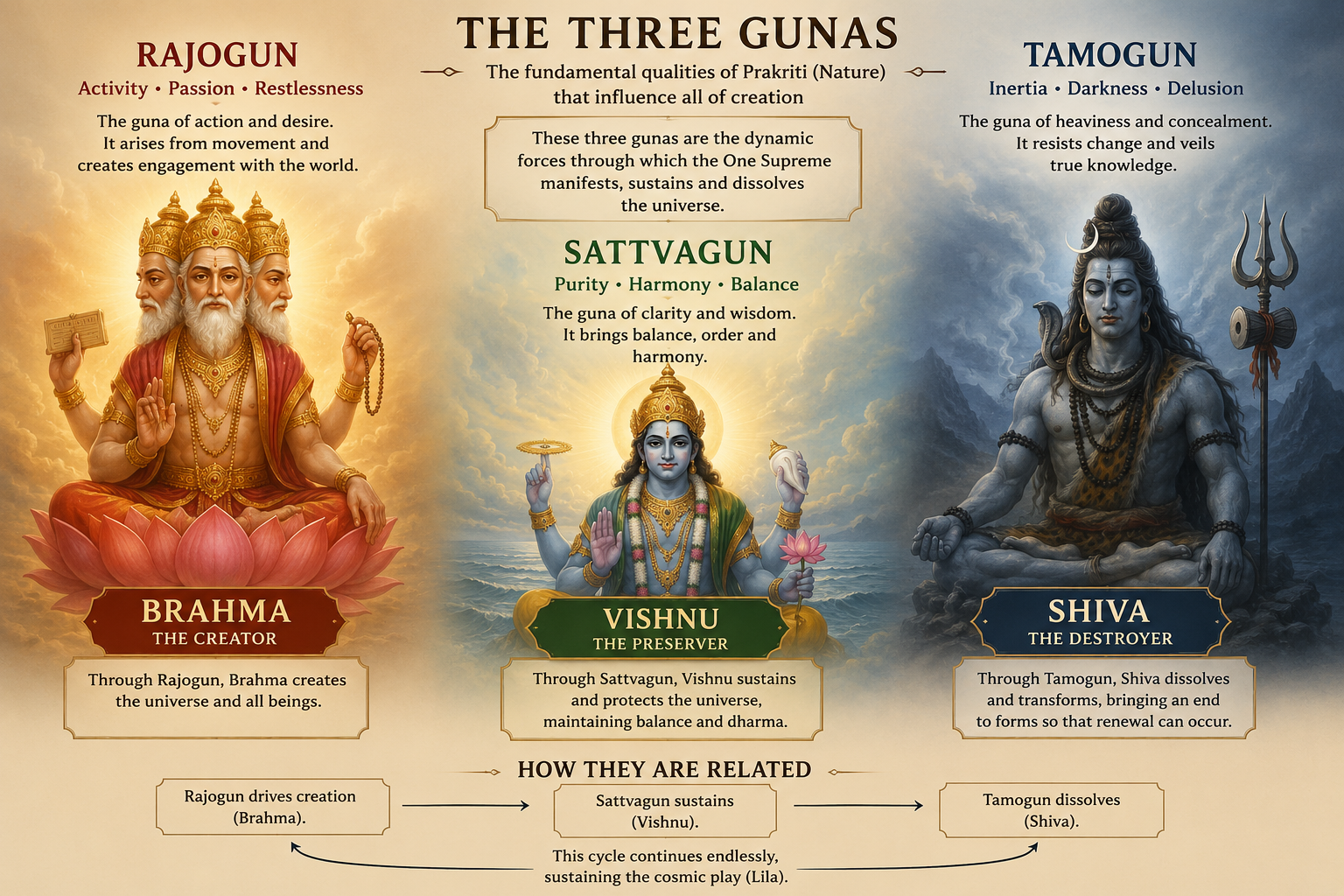
Rajogun, Sattvagun, and Tamogun are the qualities of Nature/Prakriti or Maya. All three of them are important for existence and are needed to keep a balance. In fact these three gunas are the real doers of all karmas and kriyas.
Nature is an active, or rajasic, energy. It is associated with movement/change, which gives rise to prana shakti in an organism.
Responding to the pull of the higher self, or pure consciousness, this energy becomes sattvic. It is associated with harmony, which gives rise to the mind.
By the inertia of ignorance, convenience/laziness, & or pride this same energy becomes tamasic. It is associated with inertia, which gives rise to the physical body.
The fourth Guna, Nirguna represents moksha from this mayavi world, Nature or Prakriti. Practicing this guna is impossible as long as we are inside this body which is overwhelmed by our mind & senses.
Lets understand these energies in details below:
3 – RajoGun – Prana Shakti
Rajogun (रजोगुण) is a quality which plays its role in the creation(उत्पत्ति).
This creation, good or bad, comes from the Energy or Prana Shakti, or Passion that nature has blessed a person/organism/object with. It is characterized by dawn (ब्रह्म मुहूर्त).
Anyone, who has this prana shakti in good amount, can not sit idle. Movement, activity, change naturally comes to such a person. He will create empires, art, music, dance, make discoveries, inventions, create hybrid crops, create flower gardens, airplanes, vehicles, nuclear bombs, video games, and what not.
He is the creator. Only creator. May not be the end user of that creation. For example, the founder of Telegram app, Pavel Durov avoids using most smartphones and messaging apps (tamoguna), including Telegram. Similarly, a rajasic person may have children (creation) but may not be able to give them time (nurture which is satvic guna). If both parents are rajasic, they may delay family planning or may not have children at all or just adopt an orphan and hire a nanny to raise them.
When Brahma created this world, he created not only us humans but also demons and demi gods. So, the creation can be good or bad in one’s perspective. That does not matter. What matters is that there should be a creation. If there is no creation, it is not rajas.
Rajogun-rich people are able to work hard to achieve their passion because they are high in energy. For this reason, they will never stop working. They stay active, doing things continuously all their life until they die. It does not matter how much money they have made, or how much they’ve excelled towards their passion. They simply can’t stop working towards their passion.
One example worth mentioning is Infosys co-founder Narayana Murthy who claims to have consistently worked 70 to 90 hours a week throughout his 40-plus years of professional life. He sparked a massive national debate when he suggested young Indians should work 70 hours a week to boost national productivity and compete with global economies. You can find similar, so called motivational videos on YouTube as well.
People need to under stand that Rajasic people can work long hours without stressing too much. This is not possible for people who are rich in other gunas. It is especially jealous inducing for tamasic people.
Examples: (Note: Every person has a mix of gunas. In these examples we only refer to single trait.)
- A child (Jo Naga) experimenting to see if a caterpillar’s learned experiences survive the pupal stage and can it even be passed down to its offspring.
- An artist painting a picture or a musician playing on flute.
- Invention of farming techniques, hybrid seeds, and hybrid poultry, farming of crops, dairy farms, creation of messaging app, business empire, etcetera is rajoguna.
- A person exercising and building his body to look muscular and powerful or toned (in case of females).
- An entrepreneur (Or even a house maid) working hard to create a successful business or create wealth (if that is her passion). He/She may work long hours without getting exhausted as he/she is blessed with high prana shakti.
In all five examples above, the motivation behind person’s effort decides what type of guna it is. If its out of curiosity/passion, then its rajoguna. If its a compulsion (due to debt etc), then its tamoguna or a mix of various gunas.
Side Effects: When rajogun increases out of proportion, it leads to lots of thoughts, lots of desires, competition, pride, sleeplessness, and restlessness. Rajas can become ego-driven.
Rajogun Pride: Rajasic pride is rooted in the activity level and boastfulness of their achievements, creations, or belongings. Rajasic people often start boasting about their creation, art, power, wealth, and physical beauty.
Rajogun Food: Artistic food where presentation and preparation is more important than the nutrition. Think of it like the food you get in a fine dine restaurant. It does’nt have to be expensive. It just has to be artistic and tasty.
Grade: Rajogun is better than Tamogun but Inferior to Sattva gun. Therefore, those who have achieved their passion, must try and move to Sattvagun.
6 – SattvaGun – Wisdom
Sattvagun (सत्त्वगुण) is a quality which plays its role in preservation/nurturing. (पालन पोषण). This energy to nurture comes from the pull towards the higher self or spiritual energy.
It is characterized by bright day light, service to elders and needy, harmony, truth, youth, non-violence, non-theft, non argumentative, introvert, introspective, cleanliness, purity, contentment, honesty, humbleness, and straightforwardness.
Sattvaguni persons does not aspire for materialistic things. This is because sattva brings contentment (santosha). Such a person sees money as a useful tool, not as the source of happiness. And he remains unaffected by people flaunting their achievements and possessions.
They do everything they can to help others. All they seek for themselves is peace, harmony, and time to meditate and introspect. All this is necessary to hear the subtle inner guidance, which otherwise remains unheard.
If they are not rich already, they will work to earn money that is enough to sustain their life and that of those who are dependent over them. They eat less, wear simple cloth, basically lead a simple life even if they have all the money in this world.
If they make more money than they need, they will donate it. One example is Chuck Feeney, the co-founder of the DFS group gave away his entire $8 billion fortune anonymously during his lifetime. This was eventually exposed by Forbes in 1997.
Satvik people will always do the right thing no matter if that results in loss of money, separation from family or society, or inconvenience for self or family.
Examples: (Note: Every person has a mix of gunas. In these examples we only refer to single trait.)
- A person living happily in isolation, but in harmony with nature. He would see no need to take out weeds in the garden. He will only pick dry leaves if at all, to keep cleanliness.
- A person working to accumulate a set amount of money, when he achieves his goal, he quits the money race; donates extra money (if any) and spends time in peace.
- A person practicing non violence towards humans and animals.
- A person who is devoid of anger but may take up arms to protect righteousness and maintain balance.
- A person doing yoga, meditation, or spending time in nature for relaxation or body and mind, deep thinking, or training chitta. Idea is to stay healthy, with more focus on mind than building muscles.
A sattvaguni person won’t be a role model to the large section of society. People may bow after him, may come to him with folded hand to seek blessings, but won’t aim to follow his life style. They will definitely not like their children to become a sattvaguni person.
Sattvaguni Pride: A sattvaguni is still attached to I, this is me, or this is mine feeling. A sattvik person has a burning desire to help others and save the world. It looks like a spiritual impulse but in reality, it is a deceptive trap of ego. You can help someone broken only when you thing of yourself as a savior/whole. And it satisfies your ego and results in pride of charity, philanthropy and world saving.
Sattvaguni Food: They intake limited quantity of food that is enough to sustain their life. Prefer simple, uncooked, or partially cooked food with little gravy. They prefer vegetarian food, that grows naturally.
Grade: Sattva gun is best among the three gunas of nature. Once you have achieved it, you can start the journey towards the last purushartha – Moksha; which comes through Nirgun conduct.
9 – TamoGun – Body & Senses
Tamogun (तमोगुण) is a quality which plays its role in bringing decay or destruction.
This decay or destruction comes from the needs of a body that is saturated with inertia (less of prana shakti) & darkness (less consciousness).
It is characterized by following traits:
- Inertia/Laziness and Apathy: A person dominated by tamas often lacks motivation due to lack of prana shakti or life energy (rajogun). This results in the person becoming sleepy, inactive, unmotivated, and indifferent to both personal responsibilities and the needs of others.
- Darkness, Ignorance, Delusion & Stubbornness: Darkness in tamas symbolizes the absence of clarity, wisdom, and understanding (sattvagun). It prevents a person from seeing the truth and making good decisions. He often holds mistaken beliefs about reality. To make things worse, he is unwillingness to change his views or behavior even when proven wrong or when knowing that they are wrong. A tamasic person rejects good advise and clings to harmful habits or bad decisions out of stubbornness.
- Malice: While a tamasic person is unwilling to gain wisdom or work hard; he still wants all the wealth, convenience, and sensual pleasures. When he sees rajas people become successful or famous, and sattvic people living in peace, he becomes jealous. Out of such negative emotions such as jealousy, hatred, or resentment, he develops the desire to harm, hurt, rob, fraud, or create problems for others. He/she looks for easier ways of making money like theft, begging, fraud, corruption, compromise of character, and more.
All of this results in decay and a downward spiral of consciousness.
Examples: (Note: Every person has a mix of gunas. In these examples we only refer to single trait.)
- A scientist manipulates to prepare a research report that highlights the benefits of consuming a packed food or supplement that the sponsor company has launched. The scientist completely ignores the safety of consumer and shows apathy towards consumers.
- An influencer promoting a product after accepting money or other gifts; ignoring the consequences on health of its viewers.
- Spending hours passively scrolling on devices or watching TV, playing video games, or consuming alcohol just to numb the mind rather than engaging in purposeful activity.
- Sleeping long hours throughout the day. Eating junk/packed/restaurant food and sleeping again.
- Person who focuses on faults rather than appreciation. Deliberately ruining someone’s celebration by constantly criticizing the food, arrangements, decorations, or other details.
Tamasic Pride: Tamasic pride is dangerous because it is rooted in unawareness. Such person becomes proud of the very things that are holding him back. They will do anything (argue or fight) to prove they are right.
A person becomes proud of things they didn’t even earn, or they become stubbornly attached to their own ignorance. A Tamasic person is proud of their “fixed” nature. This sounds like: “This is just how I am,” or “I don’t need to change.” This is a form of pride that rejects growth and self improvement. They feel superior by putting others down without doing any work themselves.
Tamsic Food: Packed and processed food, stale food, and intoxicants like alcohol, tobacco and marijuana. Every convenience food, packed food that can be prepared quickly is Tamasic food.
Grade: Tamogun is the worse guna of nature. If you are in this state, try moving to Rajoguna as you can not move to sattvagun directly. The Path: Tamas → Rajas → Sattva
In Short
| Action | Tamas | Rajas | Sattva |
|---|
| Donating money | To manipulate | For recognition | To help |
| Working hard | To dominate others or Theft | To achieve success | To serve a purpose |
| Studying | To cheat others | To get rank | To gain knowledge |
| Tamogun | Rajogun | Sattvagun | |
| Present in | Everyone in Different Proportion | Everyone in Different Proportion | Everyone in Different Proportion |
| The God Who Accepted This Guna (Bhagwat) | Rudra (Shiva) | Brahma | Narayana |
| Manifests | Delusion/ Destruction | Creation/ Activity | Clarity / Harmony |
| Traits | Sleep, laziness, delusion, cruelty, anger, disbelief, bad character, habit of begging, asking for bribe, inattentiveness, attachment, one-sided sex, extreme desire for money, and theft. | Hardworking, doer, speaker, sensory gratification, quarrelsome, pride, vanity, sleeplessness, egoism, enmity, and arrogance. | Non-violence, non-possession, candour, modest, continence, calm, positive demeanor, clean and orderly environment, focused on spiritual and physical well-being, compassionate care to children and elders. |
| Who to Worship and For What | Worships Shiva, Kali, Yakshas, Apsara, Pishacha etc using tantra with the aim of getting super natural powers or siddhis. | Worships Dev and Pitr with the aim of getting more money, health and wealth. | Meditates with the aim of getting peace and harmony. Cautious about karmas and the way it will affect others around him. |
| Food | Stale or pre-cooked, or packed food like processed meat, instant noodles, alcohol. | Food cooked in rich gravy or lavishing food like 7 course menu. | Sweet, juicy and palatable fruits and vegetables, preferably uncooked or cooked with minimal ingredients. |
| Side Effect | Proud of Ignorance | Proud of Wealth and Knowledge | Proud of Wisdom |
| Role in Creation of Universe | Tamas resulted in the creation of body, five elements of the universe and their tanmatras. | Tejas resulted in the creation of 5 gyan senses and 5 karma senses. | Vaikaric resulted in creation of devtas for senses and mind. |
| Vital Fluids | Urine (Dark one) | Blood (Red) | Semen (White) |
| Sexual Activity | Sex for money or pleasure alone, sex by force or sex when drunk, or sex with lack of interest by one partner. | Sex for mutual satisfaction. Often to prove oneself. If someone is passionate about it, he/she will overdo it. | Sex with no concern for sexual performance. Spiritual oneness prevails. Motive – sustaining life. |
The Journey to Satva or Nirguna
These gunas are intrinsic and deep rooted in jeev atma or chitta. When we take birth we are born with these qualities. These can be changed but it usually takes many births to develop them and therefore takes many births to change them.
The way to change them is to change your thoughts. And then you leave all three gunas and merge with the divine who is a Nirguni. But this is not easy.
For someone why doesn’t have money, wealth creation and accumulation is everything. So, Many people first pursue wealth, achievement, and recognition through rajas, discover their limitations, and only then become genuinely interested in sattva and moksha.
If you realize that your personality is tamogun rich, try moving to Rajoguna first as you can not move to sattvagun directly. The Path: Tamas → Rajas → Sattva → Nirguna/Moksha/Guṇātīta
0 – Nirguna – Pure Awareness

Sattva is a best guna among the three worldly gunas. However, it is still guided by the Ego and the pride of I. Ego is a master of disguise. When it can no longer survive on greed, wealth, or power, it puts on a white robe and calls itself a healer.
The biggest help one can do to this world is not charity or philanthropy, but the disappearance of yourself. Understand this with this example: Imagine a man asleep, dreaming of a famine hit village. In the dream, he works tirelessly. He builds farms, heals the sick, sacrifices himself to feed the dream people. He feels noble, he feels exhausted. But what is the only real way to help these dream people? To wake up! Suddenly, the suffering of dream people vanishes.
So, should we become cold? And not help someone asking for help?
There should not be any should and should nots. Whatever happens instantly, happens.
Whatever you do, do it without an ego of a doer. So, helping happens but there is no helper. And if no help happens, there is no one who did not help.
When you get a cut (injury) on your left hand, your right hand quickly covers the wound. This right hand does not write a book about its sacrifice, or demand a medal. And it doesn’t call itself a saint. it simply acts because the two hand are a part of same body. In real world also, helping happens but there is no one boasting about it.
Therefore, drop the exhaustion of fixing a universe which was never broken. The ultimate service to humanity is your own absence. When the me that desperately wants to help, dissolves; what remains is Nirguna. Pure love, acting without a name, face or memory. Wake up, and discover that the world is already saved. It is working in the way it should.
Nirgun is just the observer. He does not believe in I, this is me, or this is mine. No showoff, no competition, no bitching, no boasting of status or power. He sees the divine in all and is detached from “I.”
While Sattva involves sadhana for subduing or controlling senses; nirguna acts as the ultimate Sakshi (the silent, unattached witness) observing the play of the indriyas and the mind without becoming entangled in them.
According to the Gita, the ultimate goal is not merely sattva but becoming guṇātīta—beyond all three guṇas.
Notes:
Bhagavat Geeta Adhyay 14 Shlok 20
गुणानेतानतीत्य त्रीन्देही देहसमुद्भवान् |
जन्ममृत्युजरादु:खैर्विमुक्तोऽमृतमश्रुते || 20||
Translation: By transcending the three modes of material nature associated with the body, one becomes free from birth, death, old age, and misery, and attains immortality.
The Vedas prescribe a number of codes of conduct to transform from tamo guṇa and rajo guṇa to sattva guṇa. However, to reach sattva guṇa is not enough; it is also a form of bondage.
When we transcend the three modes, then Maya no longer binds the living being. Thus, the soul gets released from the cycle of life and death and attains immortality. Factually, the soul is always immortal. However, its identification with the material body makes it suffer the illusion of birth and death. This illusory experience is against the eternal nature of the soul, which seeks release from it. .
It is said that the worship of Brahma, Vishnu, and Shiva (three Gunas) should be abandoned and seekers should only worship Puran Parmatma (complete god) Param Akshar Brahm (‘पूर्ण ब्रह्म’, ‘परमात्मा’ या ‘पुरुषोत्तम’).
Bhagavad Gita: Chapter 14, Verse 26
मां च योऽव्यभिचारेण भक्तियोगेन सेवते |
स गुणान्समतीत्यैतान्ब्रह्मभूयाय कल्पते || 26||
The above verse indicates that mere knowledge of the self and its distinction with the body is not enough. The mind has to be fixed on the Supreme Lord. Then alone will the mind become nirguṇa (untouched by the three qualities of nature), just as Shree Krishna is nirguṇa.
Seekers who render the unadulterated worship and worship only one god [ie. those who do not worship any other deity, ghosts, pitras (deceased ancestors) and Brahma, Vishnu, Shiva] that soul is immaculate.